 The rehabilitation of a timid dog is so much more of a challenge than I would have ever expected. Don't get me wrong, I never thought helping Pixel overcome her fears and trepidation around people would be an overnight project. But I also didn't realize how it would become 3-steps-forward-1-step-back sort of scenario. Let me elaborate...
When I first brought Pixel home, I borrowed a book called Inside of a Dog (shown below) from a friend of mine that was essentially about Dog Psychology. It talks about the roots of the domesticated dogs we know of today; how they have developed; and the place they have in our modern lives. This book taught me about the all too common mistake people make of believing that dogs are just humans in dog suits. We 'humanize' dogs, and believe that they feel things the way we do, see the world the way we do, and experience memories and hopes, love and hate the way we do. In fact, these are the most common reasons for problem dogs. Human owners refuse to allow their dog to live a 'dog's life'. They stop dogs from sniffing each others behinds because of the clear boundaries humans have set up for one another that would prevent such an uncouth first meeting with another human in this manner. An interesting quote from the book on anthropomorphizing (seeing, talking about, and imagining dogs' behavior from a human-biased perspective, imposing our own emotions and thoughts on these furred creatures.) :
 We might judge an animal to be happy when we see an upturn of the corners of his mouth; such a "smile", however, can be misleading. On dolphins, the smile is a fixed physiological feature, immutable like the creepily painted face of a clown. Among chimpanzees, a grin is a sign of fear or submission, the farthest thing from happiness. Similarly, a human might raise her eyebrows in surprise, but the eyebrow-raising capuchin monkey is not surprised. He is evincing neither skepticism nor alarm; instead, he is signaling to nearby monkeys that he has friendly designs. By contrast, among baboons a raised brow can be a deliberate threat (lesson: be careful toward which monkey you raise your eyebrows). The onus is on us to find a way to confirm or refute these claims we make of animals....
When a dog approaches another dog, they don't squeal with delight the way humans do. They don't rush forward and thrust a hand out and pat the other dog on the head and coo and babble 'baby talk' the way humans do. When a dog introduces herself to another dog, she approaches the dog from the side or from the rear, sniffs his behind, and allows him to do the same. Then they move to the face and have a good sniff, and if they are mutually interested in the other dog they will either frolic companionably for a moment or they will grow bored and wander away to find the next interesting scent. What we learn from this is that when you want to introduce yourself to a dog, you never approach the dog. You allow the dog to come to you, and investigate you with her nose. Let her find out what she can about you, then when she is comfortable, you can talk to her and possibly even reward her with a pet or a treat.
This brings me quite perfectly to Pixel. Now Pixel is very shy around people. As a stray she had minimal experience with people, and those she did have experience with were probably the people who captured her, put her in a cage and brought her to the Humane Society. While rehabilitating Pixel into human society I have to be diligent in instructing new people around Pixel that they aren't to touch her or talk to her before she becomes comfortable around them and sniffs them first. This is one of the hardest parts of her rehabilitation, because most people don't realize that their automatic reaction to a dog is also the most inappropriate, and telling them as much often illicits a stunned, reproachful attitude as if I'm saying to these people "You are not good enough to talk to or touch my dog."

The food control is our latest attempt at rehabilitation. For Pixel getting food was as complicated as foraging for it, scrounging up scraps from human garbage, etc. Because Trust is pivotal in Pixel's integration into human society, she needs to trust us enough to be able to take food from us, and know that only through us she can get access to food. This will be instrumental in showing Pixel that the human world is nothing to fear. How we do this is very important. To understand food in the dog's world you have to likewise understand that how most people feed dogs is incorrect. Think, if you will, about wolves in the wild (where domestic dogs originated). Wolves hunt every day, they run, they follow scents, and when they are exhausted after such a hunt they are rewarded with food. Dogs are similar in that they require physical exercise before they are in the right state of mind to eat. Dogs, like wolves, are ingrained with a survival instinct in regards to food. They eat when food is available, and they eat as much as they can because they don't know when they may eat again. This instinct is so strong that when offered food on a nonstop basis, the dog will continually eat (simulating, for a human owner, that the dog's appetite is insatiable and they must, by our standards, by VERY hungry). Left unchecked, this can create pretty serious overweight dogs.
To wrap things up here (because this is exhaustively long!) I am going to share a number of very useful things I have learned so far about dogs and about Pixel specifically.
- To overcome something a dog is afraid of, bring them to a calm state of mind by telling them to sit. Only after they are no longer nervous and sitting calmly does a dog overcome their fear
- When correcting your dog, never use their name. A dog's name is, for them, associated with 'positive' only. So when you correct them using their name ("Butch, no!"), you are confusing them and the correction will be useless.
- When training your dog to act in the way you would like him to act, ONLY reward and praise when they are doing what you want them to be doing.
- Never 'comfort' or 'reassure' a dog that is afraid or exhibiting aggressive behavior. "It's okay" and "Don't worry" are human statements meant to reassure the human mind. The tone is that of praise, and what you are doing when saying these things to your dog is that it is okay to be afraid or aggressive. In the instance of fear, ignore the fear. In the instance of aggression, correct the behavior.
- When correcting a dog never use physical violence. Hitting your dog is not correction, it is abuse. To get the same effect, use what Cesar Millan calls the 'bite simulation'. Make a 'mouth' with your open hand; fingers splayed. Gently tap this 'mouth' on the back of your dog's neck. This simulates an alpha dog's bite, or a mother dog's bite. It will both distract and correct your dog without the use of violence.
- When leaving the house to go on walks, never let your dog go out in front of you. This makes your dog think they are the dominant member of your 'pack'.
- When walking with your dog on a leash, never let your dog choose where to go. Hold the leash next to you so that she is walking beside you, and when you want to, 'allow' her to sniff or investigate something. This will establish your position as a dominant member of your pack and will make walking off-leash easier later.
- When walking with your dog off-leash, allow him to explore the world around him, but command him to come back to you on occasion and 'check in'. Simply calling him to you, and praising him when he comes will establish the hierarchy in your 'pack'
- Walking your dog around the block so that she can 'do her business' is not exercise. Throwing a ball around for her is also not exercise. Likewise, being limited to the backyard is not exercise. Your dog needs proper exercise for her breed in order to feel that she has done her job. Do your homework about what sort of exercise is right for your dog (e.g. Retrievers need to retrieve, greyhounds need to run, collies need to herd, etc.)
- Don't fall into the trap of classifying your dog's behavior as a victim of their breed. Cesar Millan teaches that dogs are ANIMALS then DOGS then BREEDS then NAMES. This means that dogs are dogs are dogs, no matter what breed they are. Dalmatians do not behave a specific way because of their breed, they behave the way they were raised to behave. Cesar makes sure to differentiate between 'problem' breeds and 'powerful' breeds. There is no such thing as a 'problem breed'. Problems occur when an owner doesn't understand or meet the needs of their dog. 'Powerful breeds' however are very real. Pit bulls are the classic example. They are a strong dog both in will and in physical strength. But their behavior is formed by the way they are raised, not by their physical form. Again, do your homework and don't use the fallacy that your dog is the way he is because of his breed.
There are a lot more things I've learned, and as I continue to learn interesting, useful things I'll try and share them here!
Thanks for reading and I hope you are enjoying your four-legged friend as much as I'm enjoying mine!
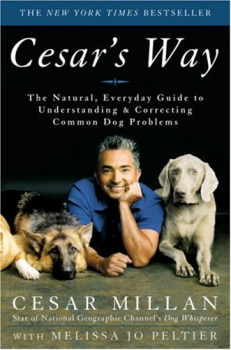
For more information about your dog and her life with you, I recommend Cesar's book Cesar's Way (shown left).
Cheers!


